

Why an Enduring Power of Attorney Is One of the Most Important Documents You'll Ever Make
We spend years planning for retirement, protecting our savings and making sure our families are financially secure. But what happens if illness or an accident leaves us unable to manage our own finances?

What Is an Enduring Power of Attorney?
In Northern Ireland, an Enduring Power of Attorney is a legal document that allows you to appoint someone you trust to manage your financial affairs if you become unable to do so yourself.
This could include accessing bank accounts, paying household bills, managing investments, collecting pension income or dealing with property.
Crucially, an EPA must be established while you still have the mental capacity to understand what you're signing. You cannot wait until you've lost capacity to put one in place.
Why Is It So Important?

Many assume their spouse, partner or children could automatically manage their finances if they became unable to do so.
Unfortunately, this isn't the case.
Even if you're married, your spouse doesn't automatically have the legal authority to access accounts held solely in your name or manage all your financial affairs.
Without an EPA, your family may need to apply to the Office of Care and Protection for a Controller to be appointed to manage your finances.
This can involve additional time, expense and administrative complexity, potentially at an already stressful time.
An EPA allows you to choose who you trust to act on your behalf, rather than leaving that decision to a court process.
How Is Northern Ireland Different from the Rest of the UK?
An important distinction is that the rules in Northern Ireland differ from those in England, Wales and Scotland.

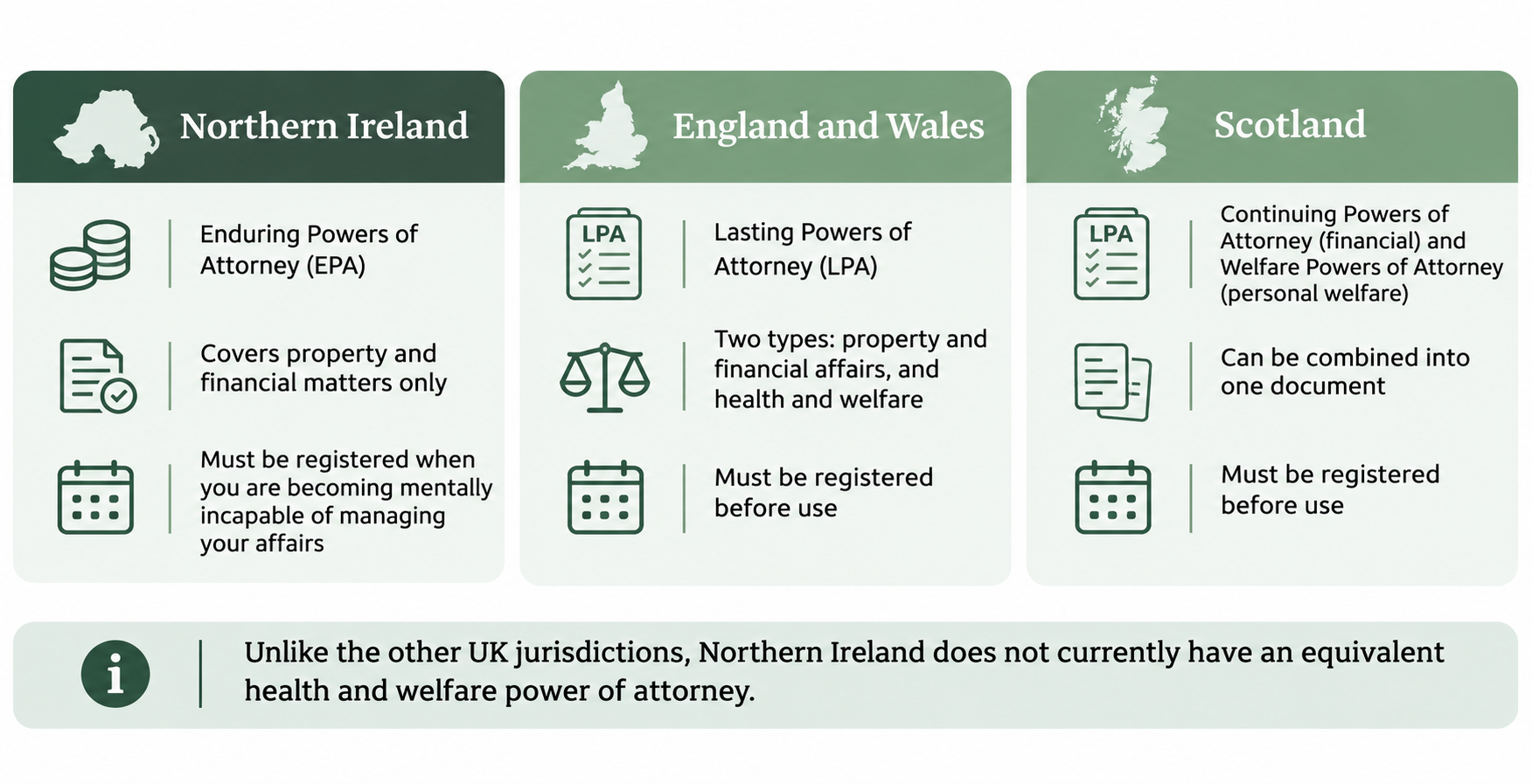
Northern Ireland: We continue to use Enduring Powers of Attorney, which cover property and financial matters only. An EPA can generally be used while you retain mental capacity, subject to its terms, but must be registered with the Office of Care and Protection when you are becoming mentally incapable of managing your affairs.
England and Wales: Enduring Powers of Attorney were replaced by Lasting Powers of Attorney (LPAs) in 2007. There are two types: one covering property and financial affairs, and another covering health and welfare decisions. LPAs must be registered before they can be used.
Scotland: There are Continuing Powers of Attorney for financial matters and Welfare Powers of Attorney for personal welfare decisions. These can be combined into one document and must be registered before use.
Unlike the other UK jurisdictions, Northern Ireland does not currently have an equivalent health and welfare power of attorney.
This is summarised in the graphic below:
Don't Leave It Until It's Too Late
One of the biggest misconceptions is that an EPA is something only older people need.
The reality is that illness, accidents and unexpected changes in health can affect anyone, at any age.
An EPA is not about giving up control of your finances. It's about making sure the right people can step in when you need them.
Just as you would make a will to protect your loved ones after your death, an EPA helps protect you and your family during your lifetime.
Make It Part of Your Financial Plan
Having an up-to-date will, appropriate insurance and a retirement plan are all important. But without an EPA, there could still be a significant gap in your financial arrangements.
If you haven't already established an Enduring Power of Attorney, now is a good time to consider it.
Speak to your solicitor about putting an EPA in place and ensure that the people you trust can support you when it matters most.
This article is for general information and does not constitute legal or financial advice. Enduring Powers of Attorney are legal documents, and professional legal advice should be sought when establishing one.